
Ethical guidelines- authors, reviewers, editors
University of Warsaw Publishing Ethics and Integrity Policy
University of Warsaw Publishing Ethics and Integrity Policy
1. Purpose and Scope
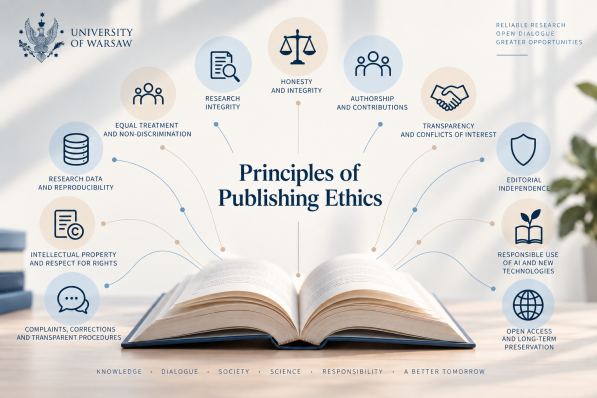
The University of Warsaw considers research integrity, editorial independence, transparency, and accountability to be fundamental principles of scholarly publishing.
This Policy sets out the general ethical standards and principles of publishing integrity applicable to publications issued by the University of Warsaw or under its auspices, including in particular scholarly journals, monographs, edited volumes, book series, book chapters, conference proceedings, and other scholarly and academic publications.
This Policy establishes a minimum institutional standard. Individual journals, book series, organisational units, and other entities conducting publishing activities within the University of Warsaw may adopt more detailed policies appropriate to their discipline, type of publication, and publishing model, provided that such policies are consistent with this Policy.
Where appropriate to a particular type of publication, the University of Warsaw follows the principles and recommendations of the Committee on Publication Ethics (COPE) and other internationally recognised standards of publication ethics and research integrity.
2. Role of the University of Warsaw
The University of Warsaw provides an institutional framework for responsible scholarly publishing and supports high academic, editorial, and ethical standards.
As the owner, organiser, or institutional publisher of scholarly publications, the University is committed in particular to:
- supporting the integrity and reliability of the scholarly record;
- safeguarding editorial independence;
- promoting transparent publishing procedures;
- preventing and addressing research and publication misconduct;
- ensuring that credible allegations of ethical misconduct can be appropriately reported and investigated;
- supporting appropriate procedures for corrections, retractions, removal, or other amendments to published content;
- supporting the long-term preservation, accessibility, and integrity of scholarly publications;
- promoting responsible use of new technologies, including artificial intelligence.
The University does not replace editors, academic editors, editorial boards, or other bodies responsible for the scholarly evaluation of individual publications.
3. Editorial Independence
The University of Warsaw respects and safeguards the principle of editorial independence.
Decisions concerning the acceptance, peer review, rejection, publication, correction, or retraction of individual works should be made by the appropriate editors or other authorised publishing bodies in accordance with scholarly, editorial, and ethical criteria.
Editorial decisions must not be influenced by political, ideological, commercial, reputational, or institutional considerations unrelated to the scholarly or editorial assessment of the material.
In particular, a publication concerning the University of Warsaw, its authorities, employees, organisational units, projects, partners, or funders must not receive more favourable or less favourable treatment solely because of that relationship.
Financial support provided to a journal, book, series, publishing project, or organisational unit must not constitute grounds for interference in decisions concerning individual publications.
4. Responsibility for Published Content
Authors are responsible for the content of their publications, including the results, data, interpretations, opinions, conclusions, sources used, and compliance with the rights of third parties.
Editors and other persons involved in publishing decisions are responsible for performing their duties in accordance with applicable editorial policies and recognised standards of publication ethics.
The views, opinions, interpretations, and conclusions expressed in publications are those of their authors and do not necessarily reflect the position of the University of Warsaw, its authorities, or its organisational units.
Publication by the University of Warsaw or under its auspices does not constitute institutional endorsement of, or agreement with, the views expressed in a publication.
Nothing in this provision limits any responsibility of the University arising under applicable law or its responsibility for supporting appropriate standards of scholarly and publishing integrity.
5. Research and Publication Integrity
The University of Warsaw does not tolerate practices that compromise research or publication integrity.
Potential forms of misconduct include, but are not limited to:
- fabrication or falsification of data, results, research materials, tables, figures, or images;
- plagiarism;
- unauthorised use of another person's ideas, data, or materials;
- duplicate or redundant publication;
- undisclosed reuse of previously published material;
- inappropriate attribution of authorship;
- ghost, guest, gift, or honorary authorship;
- manipulation of the peer-review process;
- citation manipulation;
- failure to disclose a significant conflict of interest;
- use of protected material without the required permission;
- violation of ethical standards applicable to research;
- presentation of manipulated or false information regarding the research or publishing process;
- organised activities intended to circumvent established publishing standards, including so-called paper mills;
- any other conduct that may compromise the integrity of the scholarly record.
These principles reflect the types of misconduct already identified in the University of Warsaw journal-level ethics framework, including plagiarism, data falsification, manipulation of figures, tables or citations, authorship problems, peer-review manipulation, undisclosed conflicts of interest, and paper-mill activity.
6. Authorship and Contributions
Authorship should accurately reflect a substantial and genuine contribution to the publication.
Persons listed as authors should:
- have made a genuine intellectual contribution to the work;
- be familiar with and approve the final version of the publication;
- be prepared to take responsibility for their contribution;
- cooperate in resolving questions concerning the accuracy or integrity of the publication.
Persons whose contribution does not meet the criteria for authorship should be appropriately acknowledged as contributors or in another suitable form.
The University of Warsaw supports transparent reporting of individual contributions and, where appropriate, the use of the Contributor Roles Taxonomy (CRediT).
The following practices are not acceptable:
- ghost authorship – failure to identify a person whose contribution warrants authorship;
- guest authorship – listing as an author a person who has not made an appropriate contribution;
- gift or honorary authorship – granting authorship for reasons unrelated to a genuine contribution to the publication.
The underlying journal policy already distinguishes between authors and contributors and supports transparent contribution statements, including CRediT.
7. Conflicts of Interest
Authors, editors, reviewers, and other persons involved in the publishing process should disclose actual or potential conflicts of interest that could influence, or reasonably be perceived as influencing, their judgement or decisions.
Conflicts of interest may include, among others:
- financial interests;
- professional relationships;
- personal or family relationships;
- organisational interests;
- academic interests;
- competitive interests;
- institutional interests.
Particular care should be taken where a publication concerns the University of Warsaw, its authorities, organisational units, projects, employees, partners, or funding bodies.
In such cases, the assessment and decision-making process should be organised in a way that ensures the greatest possible independence of those involved.
Disclosure of a conflict of interest does not automatically exclude a publication from consideration. The conflict should be appropriately assessed and managed.
The University journal-level policy already adopts a broad concept of competing interests, including financial and personal relationships, employment, consultancy, honoraria, funding, and relationships involving editors, reviewers, and the publisher.
8. Peer Review and Scholarly Evaluation
The method of evaluating a publication should be appropriate to the type of publication and the standards of the relevant discipline.
Journals, book series, and other publishing entities should provide clear information about the review or evaluation model they apply.
Reviewers should act:
- impartially;
- independently;
- within a reasonable timeframe;
- constructively;
- with due respect for confidentiality;
- with an obligation to disclose conflicts of interest.
Materials provided for confidential review must not be used by reviewers for personal advantage or disclosed to unauthorised persons.
The University of Warsaw does not impose a single mandatory peer-review model for all types of publications. Detailed review procedures are determined by the relevant journals, series, publishing entities, or organisational units.
9. Artificial Intelligence and AI-Assisted Technologies
Artificial intelligence systems, including generative AI and large language models, cannot be recognised as authors of scholarly publications.
Authors remain fully responsible for any content prepared with the assistance of such tools.
Where the use of AI tools has materially contributed to the preparation of text, analysis, research materials, images, or other elements of a publication, such use should be disclosed in accordance with the rules applicable to the relevant publication.
AI tools must not be used in a manner that:
- breaches the confidentiality of the editorial or peer-review process;
- results in disclosure of unpublished material to unauthorised third parties;
- infringes copyright, data rights, or other third-party rights;
- replaces human responsibility for editorial or peer-review decisions;
- results in the fabrication of references, data, findings, or other information.
Editors and reviewers should exercise particular caution before submitting unpublished manuscripts, reviews, research data, or other confidential material to external AI systems.
The underlying journal ethics policy already requires disclosure of the use of AI-assisted technologies, including large language models, chatbots, and image-generating tools.
10. Research Data and Reproducibility
The University of Warsaw supports research transparency and responsible sharing of research data in accordance with applicable law, ethical requirements, funder requirements, and legitimate restrictions concerning privacy, confidentiality, and third-party rights.
Where appropriate, authors should make available the data supporting published findings or explain why access to such data is restricted.
The University supports the FAIR principles – Findable, Accessible, Interoperable and Reusable – and the responsible use of trustworthy data repositories.
Authors should appropriately cite datasets and other research materials used in their publications.
11. Research Involving Human Participants and Other Matters Requiring Ethical Oversight
Publications reporting research that requires approval by an appropriate ethics committee, informed consent from participants, or other authorisation should provide information confirming that the relevant requirements have been met.
Authors are responsible for obtaining all approvals and permissions required by law or applicable ethical standards.
Personal data, sensitive data, confidential information, and other materials whose disclosure may infringe the rights or legitimate interests of third parties require particular protection.
12. Intellectual Property and Third-Party Rights
Authors are responsible for ensuring that material submitted for publication is original and that the use of works, data, illustrations, tables, photographs, and other third-party materials complies with applicable law.
Where permission from a rights holder is required, the author is responsible for obtaining such permission before publication.
Licensing arrangements, the rights retained by authors, and the conditions applicable to reuse are determined by the policies governing the relevant journal, series, or other type of publication.
The University of Warsaw supports open access to research outputs; however, this Policy does not establish a single mandatory Creative Commons licence for all publications.
13. Reporting Publication Ethics Concerns
The University of Warsaw supports the good-faith reporting of credible concerns regarding research or publication misconduct.
Concerns may relate both to material undergoing the publishing process and to material that has already been published.
A concern relating to a specific publication should normally first be addressed to the relevant editorial office, academic editor, publishing unit, or other contact indicated for that publication.
Where:
- the concern relates to the Editor-in-Chief or the person normally responsible for handling the matter;
- there is a significant conflict of interest;
- the matter appears to be systemic;
- the matter cannot be appropriately resolved at the level of the relevant publication or organisational unit;
the concern may be referred to the appropriate University-level unit:
Research Services Office
E-mail: ja.lewczuk@uw.edu.pl
Concerns should be handled impartially and with appropriate confidentiality, taking into account the nature of the case and applicable regulations.
The submission of an allegation does not in itself establish that misconduct has occurred. Persons concerned by an investigation should be given an appropriate opportunity to respond to material allegations.
14. Handling Allegations of Misconduct
Where there are reasonable grounds to suspect a breach of ethical standards, the appropriate editors, publishing unit, or – where the nature of the case so requires – the appropriate body of the University of Warsaw should take steps to establish the relevant facts.
The procedure should reflect the nature and seriousness of the alleged breach and should be conducted with due regard to proportionality, impartiality, and confidentiality.
Depending on the circumstances, it may be appropriate to cooperate with:
- authors;
- editors;
- reviewers;
- the author's employing institution or organisational unit;
- the institution at which the research was conducted;
- the funding body;
- rights holders;
- an appropriate committee or other University body;
- another institution authorised or competent to investigate the matter.
In publication ethics matters, relevant COPE guidance and procedures should be taken into account, where appropriate.
15. Complaints and Appeals
Participants in the publishing process should have the opportunity to submit complaints concerning, among other matters:
- editorial procedures;
- the peer-review process;
- breaches of confidentiality;
- conflicts of interest;
- the conduct of an editor, reviewer, or other participant in the publishing process;
- unreasonable delays;
- the handling of suspected misconduct;
- published material.
Dissatisfaction with the scholarly merits of an editorial decision does not in itself justify changing that decision where the established procedures have been properly followed.
An appeal procedure must not result in administrative authorities of the University replacing the appropriate editor or editorial board in the academic evaluation of a publication.
Where a complaint cannot appropriately be resolved by the relevant journal, editor, or publishing unit, it may be referred to:
Research Services Office
E-mail: ja.lewczuk@uw.edu.pl
16. Corrections, Notices and Retractions
The integrity of the scholarly record requires mechanisms for correcting information that is found to be erroneous, unreliable, or misleading after publication.
Depending on the nature and significance of the issue, the appropriate response may include:
- a correction;
- an erratum;
- a corrigendum;
- an addendum;
- an editorial note;
- an expression of concern;
- a retraction notice.
Retraction is not intended as a punishment of the author. Its primary purpose is to correct the scholarly record and inform readers that the findings, data, or other significant elements of a publication cannot be relied upon, or that the publication involved a serious breach of applicable standards.
A retraction notice should remain publicly accessible and clearly linked to the original publication.
The existing journal-level policy provides for addenda, editorial notes, expressions of concern, corrections, retractions and corrigenda, as well as substantive grounds for retraction.
17. Removal of Published Content
Complete removal of published content should be exceptional.
As a general rule, errors and integrity concerns should be addressed in a manner that preserves a transparent record of the history of the publication.
Removal may be justified, in particular, where continued availability of the material:
- violates applicable law;
- poses a serious risk to safety;
- seriously infringes privacy or other rights that cannot adequately be protected through less restrictive measures;
- is prohibited by a binding decision or order of a competent authority.
Where possible, the metadata of the publication and an explanatory notice should be retained rather than removing the entire publication record.
18. Preservation and Archiving
The University of Warsaw supports the long-term preservation and accessibility of its scholarly publications.
Units conducting publishing activities should apply appropriate archiving and preservation arrangements for the relevant type of publication and comply with applicable legal deposit and archiving requirements.
The discontinuation of a journal, book series, or publishing project should not, where legally and technically possible, result in the loss of access to previously published scholarly content.
19. Funding, Sponsorship and Advertising
Sources of funding for publishing activities should be transparent.
Funding, sponsorship, advertising, or other economic relationships must not influence the scholarly assessment of individual publications.
Advertising or sponsored content, where accepted, should be clearly distinguishable from scholarly and editorial content.
A commercial partner, sponsor, or funding body must not have the right to interfere with the outcome of an independent scholarly review solely on the basis of providing financial support.
20. Confidentiality
Unpublished materials submitted as part of an editorial or peer-review process should be treated as confidential.
Persons with access to such materials must not:
- disclose them to unauthorised persons;
- use unpublished ideas, data, or results for personal advantage;
- use the materials in a manner that may prejudice their authors;
- use them to train, test, or supply external technological systems where this would result in the loss of control over confidential material.
Confidentiality also applies to the handling of complaints and allegations, except where disclosure is necessary for the proper investigation of the matter or required by law.
21. Freedom of Research and Academic Freedom
The University of Warsaw respects freedom of scientific research, academic freedom of expression, and open scholarly debate.
The controversial nature of a topic, result, hypothesis, opinion, or conclusion does not in itself constitute grounds for refusing publication, correcting a publication, or retracting it.
Restrictions on publication may arise from applicable law, ethical requirements, lack of appropriate research integrity, or failure to meet the scholarly and editorial standards applicable to the publication. They should not arise solely because a publication is critical of the University of Warsaw, its organisational units, authorities, policies, or activities.
22. Equal and Non-Discriminatory Treatment
Materials submitted for publication should be evaluated according to criteria appropriate to their scholarly and editorial character.
Publishing decisions should not be influenced by characteristics of authors that are unrelated to the quality or nature of the work.
The University of Warsaw supports publishing processes conducted with respect for the dignity of all participants and without unlawful discrimination.
23. Protection of the Scholarly Record
Responsibility for scholarly publishing does not end when a work is published.
Where credible information suggesting a serious error, misconduct, or legal concern emerges after publication, it should be appropriately considered regardless of the time elapsed since publication.
The University of Warsaw supports a model in which the history of significant changes to published material remains, wherever possible, transparent to readers.
24. Relationship with Policies of Individual Publications
Journals, book series, and organisational units publishing under the auspices of the University of Warsaw should maintain or make available policies appropriate to the nature of their publishing activities.
Such policies may include, in particular:
- peer-review procedures;
- instructions for authors;
- authorship criteria;
- conflict-of-interest disclosure procedures;
- research data policies;
- policies on the use of artificial intelligence;
- policies concerning preprints and prior dissemination;
- Open Access policies;
- licensing terms;
- publication fees;
- complaints and appeals procedures;
- correction and retraction procedures;
- archiving policies.
Where a local policy does not address a particular issue, the relevant principles of this Policy and recognised good practice in publication ethics should apply.
25. Updating the Policy
Standards of publication ethics evolve in response to developments in research, technology, law, and scholarly communication.
The University of Warsaw may periodically update this Policy to reflect changes in applicable law, COPE recommendations, internationally recognised standards of research integrity, and emerging challenges in scholarly publishing.
26. Contact
Questions concerning this Policy may be addressed to:
Research Services Office
E-mail: ja.lewczuk@uw.edu.pl
Concerns relating to a specific article, book, chapter, or other publication should normally first be submitted to the relevant editorial office, academic editor, or publishing unit identified for that publication.
Where the matter cannot appropriately be resolved at that level, or where a conflict of interest or other circumstances justify escalation, it may be referred to the Research Services Office at ja.lewczuk@uw.edu.pl.
Disclaimer
The views, opinions, interpretations, and conclusions expressed in publications issued by the University of Warsaw or under its auspices are those of their authors and do not necessarily reflect the position of the University of Warsaw, its authorities, or its organisational units.
Authors are responsible for the scholarly content of their publications.
The University of Warsaw supports recognised standards of research integrity and publication ethics and takes appropriate steps to protect the integrity of the scholarly record.